SillyTavern Memory Without Summaries: What SillyMemory Changes
A SillyTavern summary keeps the plot but drops the exact line a character said earlier. What does SillyMemory pull back instead, and what does its 95% token cut really measure?
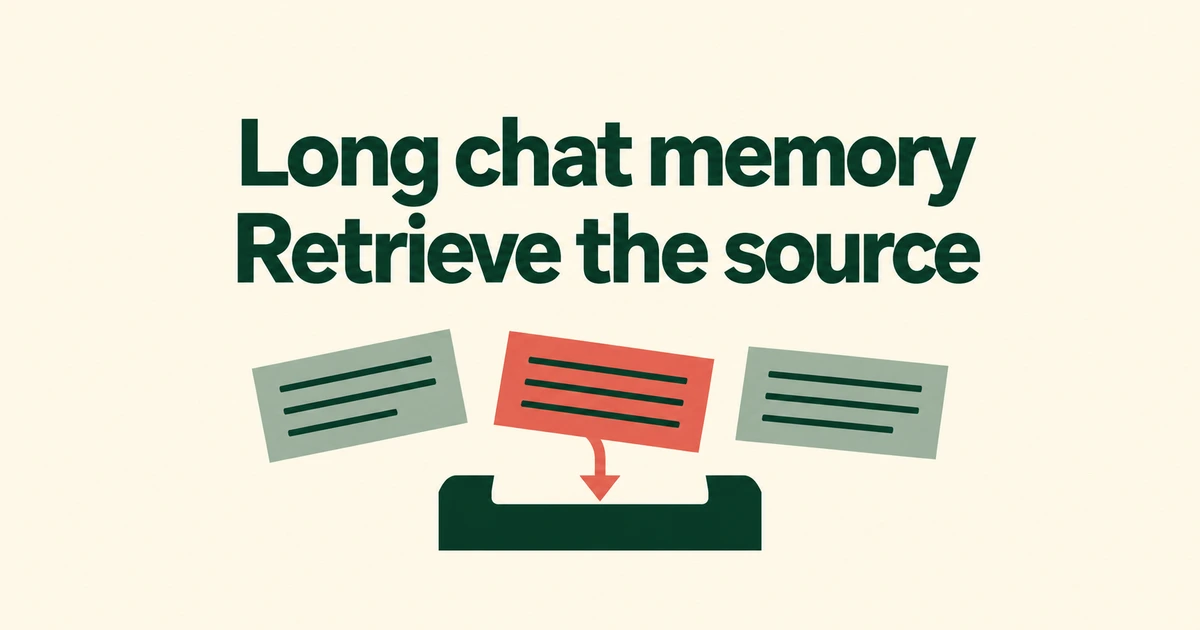
- SillyMemory combines retrieved source passages with recent conversation.
- The reported 95% reduction concerns answer input tokens in a specific evaluation.
- The extension is experimental and uses external memory infrastructure.
Old details can return as source passages
A larger context window is one way to keep a long conversation available. Retrieval offers another: select relevant older passages for each answer. LambdaDB’s introduction describes a pipeline that preserves original wording, searches it and reranks the results without building a knowledge graph or generating rewritten memories.
SillyMemory brings that approach to SillyTavern. Avoiding generative memory bookkeeping does not eliminate embeddings, retrieval or the model that answers. It changes which historical evidence reaches that model.
Summary and retrieval solve different parts of the problem
Summarize creates a compact account of events. Its documentation explicitly notes that details may disappear or invented information may enter the summary. You can edit the current summary or restore an earlier one when that happens.
| Option | What comes back into context | What to inspect |
|---|---|---|
| Summarize | A generated account of the conversation | Whether the summary retained the important facts |
| Chat vectorization | Relevant older messages | The query messages and insertion settings |
| SillyMemory | Ranked source passages alongside recent messages | The selected passages and final prompt |
There is a naming trap in Vector summarization. It can summarize a message before constructing its search vector, but a match brings the original message back into context. It does not simply compress the entire chat. That distinction matters when deciding what a memory toggle will actually change.
The 95% figure is an input-token result
The team’s published LongMemEval-S report records 480 correct answers out of 500 for SillyMemory, versus 476 for the full-history reference. Average answer input fell from about 105,183 tokens to 4,886, a 95.35% reduction.
The report says the four-answer difference does not establish general superiority. The useful finding is similar measured quality with much smaller inputs under those configurations. Preparing and searching memory still incurs work, so the percentage is not a promised reduction in your total bill.
Start with a test chat and inspect the evidence
The installation guide labels this an experimental prerelease, tested with SillyTavern 1.19.0 and Chromium. You need an existing chat-model connection and a LambdaDB project.
- Install
https://github.com/lambdadb/SillyMemorythrough Extensions, then reload. - Enter the project endpoint, name and key in SillyMemory, then select
Connect and prepare. - Open a saved test chat and enable memory from its Memory panel. Wait for synchronization and disable built-in chat vectorization and competing history-rewriting extensions.
The original chat remains intact. Searchable older text, metadata and queries are processed by LambdaDB and its managed inference providers; chat-model charges remain separate. Use the passage preview and full-memory view to check whether an answer received the earlier statement it needed. That gives you something more useful to evaluate than a memory setting merely being switched on.