Does WorldTUI Run a Real Shell or Just Predict One?
In WorldTUI, a file you just appended to comes back empty, and a misspelled pythoon command still answers like Python. What is actually behind that terminal?
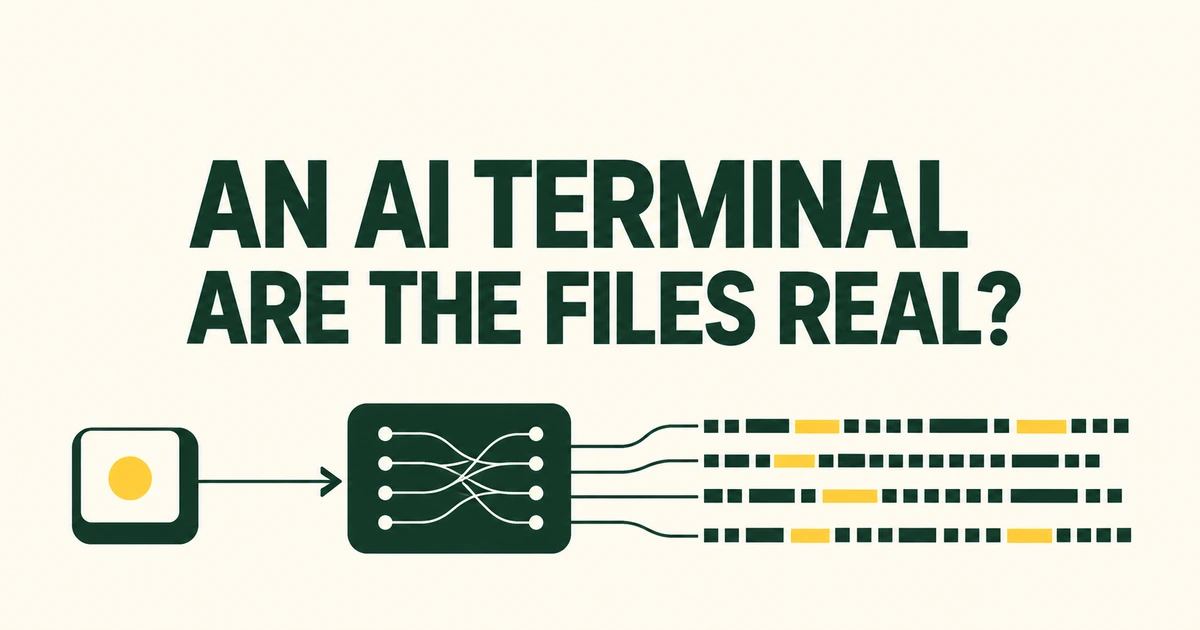
- A model predicts the display; no shell runs behind the simulated terminal.
- Apparent files live in the model’s context, not on a real filesystem.
- The browser demo lets you choose a starting screen and run inference on your GPU.
A successful-looking command is still a prediction
When a reader asked whether WorldTUI creates real files, creator Simon Edwardsson answered that they exist only in the model’s context. A filename on screen is part of the simulated state, not a file written to your computer.
The demo explicitly says no shell is running. Its input is a keypress and its output is a predicted display update. A save confirmation therefore cannot serve as evidence that a filesystem write completed.
Choose a screen, then load the model
Open the WorldTUI demo in a desktop browser; the site recommends Chrome or Edge. Its controls give you a short route into the experiment:
- Select a starting screen with
Start from. - Choose
Load modeland begin typing. - Use
Inspectorto examine display changes and latency. The demo labelsCtrl+Ras its reset shortcut.
You can also supply a custom starting screen. That asks the model to continue an apparent session; it does not attach to an existing process.
The computation itself is real and local. WebGPU gives web applications access to the device’s GPU for computation. GPU inference in a tab and execution of the displayed shell commands are different things.
The base model and the terminal model are different artifacts
The Qwen2.5-Coder-0.5B model card describes a pretrained code model with about 0.49 billion parameters, including about 0.36 billion outside its embeddings. Downloading that base model alone does not reproduce WorldTUI.
In his project write-up, Edwardsson explains that removing most unused vocabulary embeddings reduced the terminal model to roughly 360 million parameters. Four-bit quantization then brought its download to 208 MB. That download size is not a total runtime GPU-memory specification.
The interesting test is what survives the next interaction
Edwardsson reports appended file contents disappearing on readback, and a misspelled pythoon command producing a Python-like response. Familiar output can coexist with broken state or different rules from the real program.
One useful way to explore the demo is to edit an apparent file, do something else, then read it again. The question is whether the model carries the earlier information forward. A plausible screen alone does not establish that storage or code execution occurred.
WorldTUI is an experiment in maintaining an interactive world through prediction. Its appeal lies in watching where that world remains coherent—and where it stops behaving like the machine it resembles.