GPU-unlock on RTX 30: Why Twice the Issue Rate Is Not Twice the AI Speed
An RTX 3090 owner saw 16k prompts process faster after GPU-unlock, but generation stayed near 97 tokens per second. Which part of your AI workload does the doubling reach?
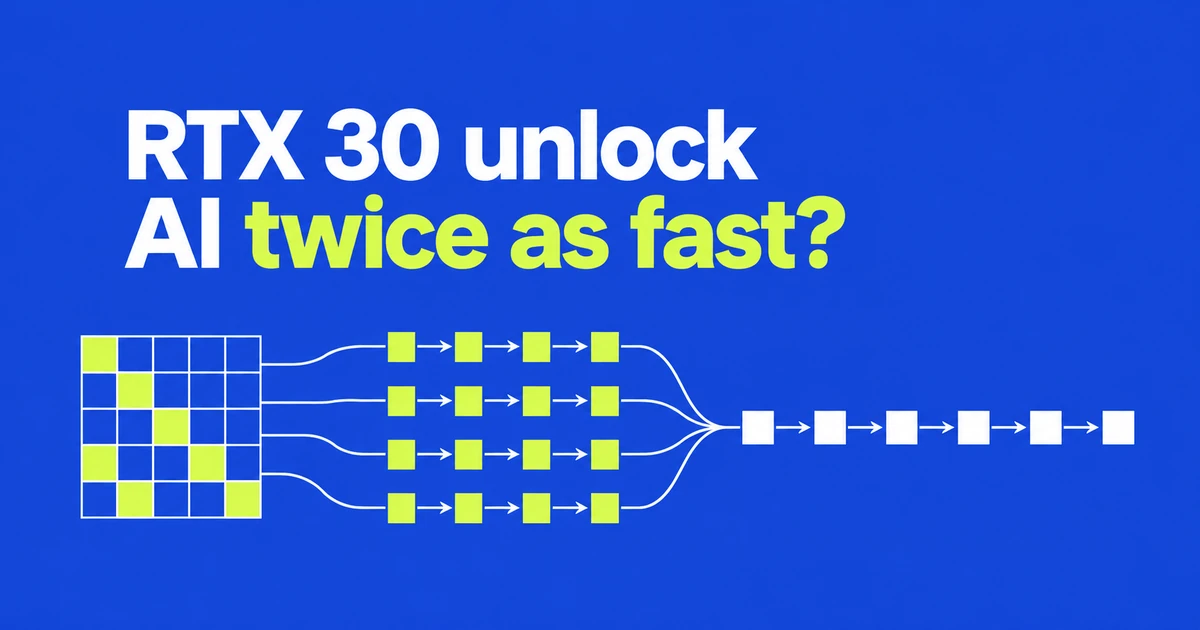
- The claimed doubling applies to specific instruction issue rates, not an entire AI application.
- One RTX 3090 report found higher 16k prompt throughput with almost unchanged decode speed.
- Compare prefill and generation separately under matching card, power and precision conditions.
The claim is about instruction issue rate
Zagitta’s GPU-unlock describes a doubling of instruction issue speed for FP16/BF16 operations accumulating into FP32 on GA102, GA103, GA104 and GA106. Accumulation is the running addition of multiplication results; its precision is part of the claim.
The module operates early in Linux boot, before the NVIDIA driver binds the card. The project describes changing hardware selectors and resetting the GPU before the normal driver takes over. This is a change to boot-time device handling, rather than a setting inside an AI application.
The reported gains differ even within one card
The README points to applepines’ RTX 3090 Ti experiment: a 450 W limit, dense 8192³ GEMM, FP32 accumulation and medians of five samples.
| Input | Before | After | Calculated gain |
|---|---|---|---|
| FP16 | 87.46 TFLOPS | 118.39 TFLOPS | About 35% |
| BF16 | 87.50 TFLOPS | 157.41 TFLOPS | About 80% |
Those original runs used a modified NVIDIA 610.43.02 driver and a custom pre-udev initramfs hook. The current project’s description of operation with an unmodified driver does not retroactively change the setup behind this table.
The percentages are calculated from the reported measurements. They describe matrix throughput, not the elapsed time of an entire chatbot request or image-generation job.
Prompt processing and generation have different bottlenecks
NVIDIA’s inference guide separates prefill, which processes input tokens in parallel, from decode, which generates subsequent tokens sequentially. Moving model data and state from memory can dominate decode latency.
One report by robertoetcheverryr on a Zotac RTX 3090 capped at 350 W illustrates the distinction. At 16k context, prompt throughput rose from 2,594 to 3,009 tokens per second, while decode changed from 96.8 to 97.2. The user compared a baseline from the previous day with the unlocked run; 4k prompt throughput was also essentially flat.
The useful question is which phase consumes time in the intended workload. A gain while reading a long prompt can matter without producing a similar gain while writing the answer.
A successful unlock message does not establish a speedup
A report for a GA102-250 RTX 3080 Ti 20 GB OEM card describes a completed unlock and retained selector values, but no BF16 uplift. The author explicitly distinguishes this board from the retail 12 GB model. The suggested fuse-related explanation remains a hypothesis.
Boot ordering matters too. The project states that manually loading the module after the NVIDIA driver has already bound the card does not affect it. Card identity, measured throughput and whether the early-boot sequence actually ran are separate checks.
FAQ
Does every RTX 30 card get the same benefit?
No. A targeted chip does not guarantee the same benefit on every card, and the OEM report shows that a completed sequence can produce no uplift.
Can the GEMM gain predict decode throughput?
No. Memory traffic and the workload’s mix of operations affect the result.
Evaluate elapsed time in the intended workload, with card and power conditions held consistent. Measure prompt processing and generation separately before treating an unlock as an application speedup.