Can TornadoVM 7 Run Your Existing Java App on a GPU?
Your Java service runs fine on the JVM, and you want TornadoVM 7 to put it on a GPU. Which code makes the trip, and what do you have to write yourself?
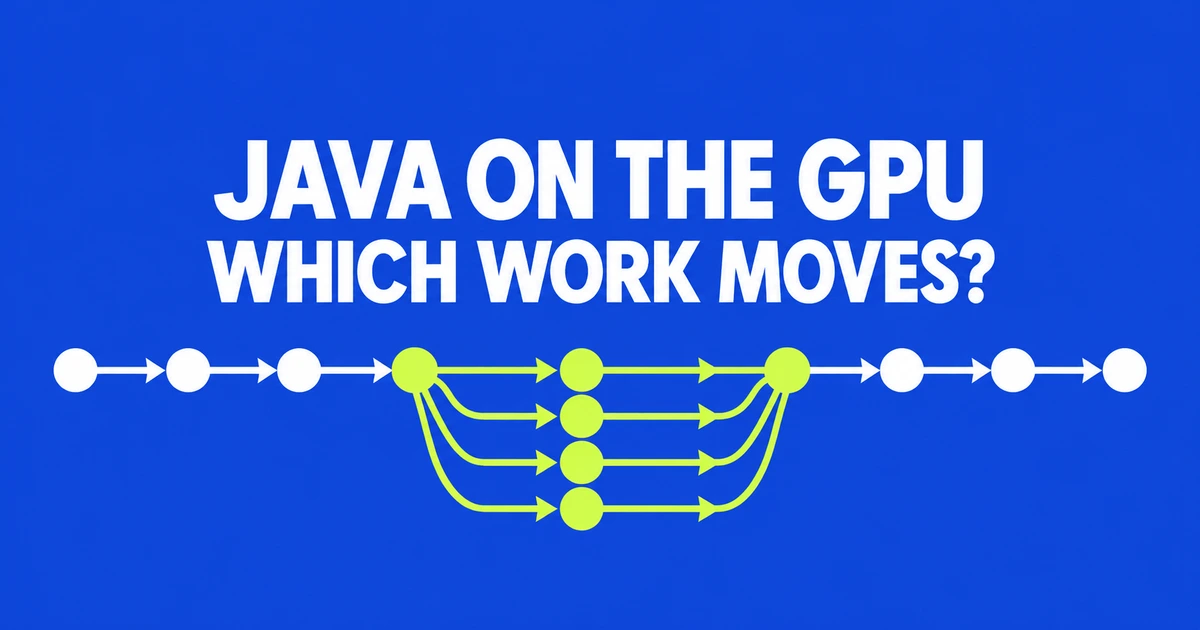
- TornadoVM offloads selected Java computations; it does not automatically parallelize the whole app.
- Developers supply suitable data representations, parallelism, task graphs and execution plans.
- Native GPU libraries can join Java-defined kernels, with backend-specific requirements.
The unit of acceleration is a selected computation
Adding TornadoVM does not send an entire existing Java application to the GPU. Its programming guide explicitly says it does not auto-parallelize Java methods. Developers express parallel work and select the methods to accelerate.
Matrix multiplication illustrates the distinction: independent output elements can be computed in parallel. TornadoVM compiles and dispatches that selected work while host code remains in the Java application.
The project currently advertises 7.3.1 with JDK 21–27 support. The October release notes add options such as Apple MLX library tasks on Metal. Those additions expand what a Java application can call without removing the need to define its compute path.
Four decisions connect a method to an accelerator
Start with a supported data representation, such as FloatArray, and describe the parallel computation. Group methods and transfers into a TaskGraph, then run an execution plan.
| Decision | Purpose |
|---|---|
| Data representation | Use arrays, matrices or other supported types with known memory layouts. |
| Parallelism | Annotate loops with @Parallel, or use KernelContext or TileContext. |
| TaskGraph | Identify methods and the data moving into and out of the device. |
| Execution plan | Run the graph and configure device selection, warm-up or profiling. |
A graph describes work. Calling execute() on its execution plan starts that work; constructing a graph alone does not launch the computation.
The GPU path supports a subset of Java
The 7.3.1 documentation rules out recursion and restricts dynamic memory allocation. Arbitrary application objects cannot simply be carried into a GPU kernel.
That is narrower than saying “no objects.” TornadoVM understands the layouts of its supported array, vector and matrix types. Its compiler can also handle some allocation cases when it can determine sizes at runtime. For an existing codebase, the useful question is whether the hot computation can be expressed using those supported forms.
Keep custom kernels and vendor libraries in one graph
The Hybrid API combines JIT-compiled Java tasks with native-library tasks. A graph can preprocess data in a Java-defined kernel, call cuBLAS for matrix work, then postprocess the result with another kernel.
These tasks share TornadoVM-managed device buffers. An intermediate result can remain on the GPU across the boundary between generated code and a library call.
Provider requirements still matter. NVIDIA providers require CUDA and an NVIDIA GPU; Apple MLX requires Metal on Apple silicon. A library task on an unsupported backend is reported as UNSUPPORTED. A Java call does not make a vendor library portable to every GPU.
Measure the time to get a usable result back
Transfer frequency is part of correctness as well as performance. The team’s data-transfer explanation distinguishes EVERY_EXECUTION from FIRST_EXECUTION: changing host-side inputs after a first-only transfer does not itself send new values to the device.
Copying results back can also narrow the benefit of a faster kernel. In its 6.0 performance discussion, the TornadoVM team separates kernel-only improvements from elapsed time that includes a host copy-back. A benchmark of only the inner computation does not answer how long the application waits for the result.
A practical first evaluation is one hot computation, with output checks and elapsed-time comparisons against the existing JVM implementation. The decision turns on parallel work, compatible data structures and transfer costs—not on how much of the application happens to be written in Java.