Codex Was 63% Cheaper, but the Developer Still Chose Claude Code
A same-prompt dashboard test comparing Claude Code and Codex on completion time, cost, weekly usage and product polish.
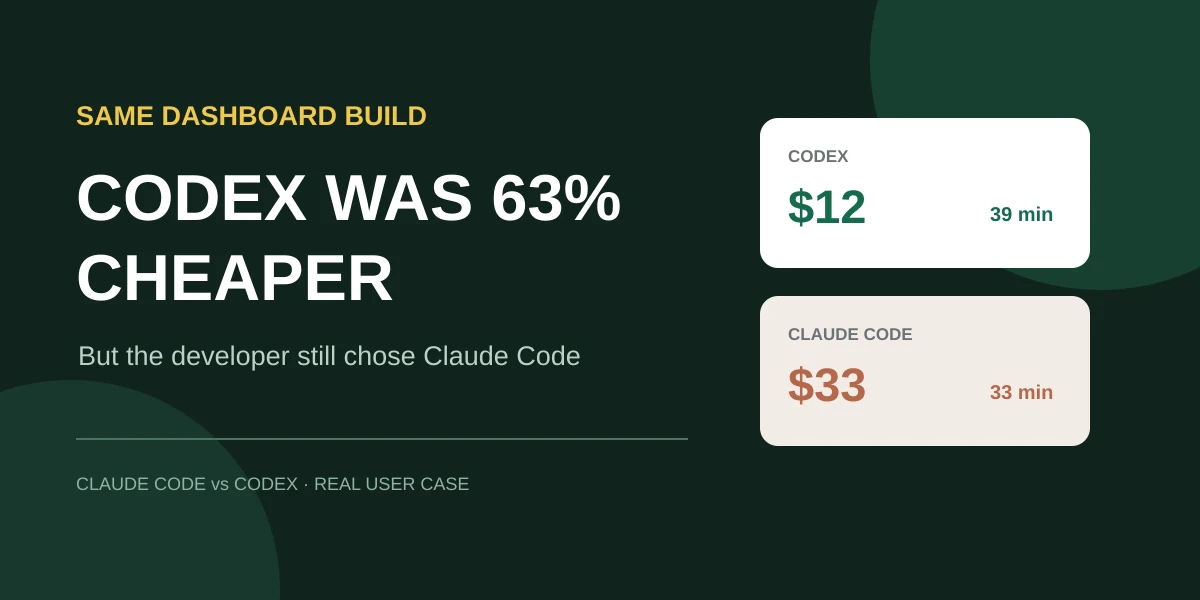
- Codex built the dashboard for about $12; Claude Code cost about $33.
- Claude finished in 33 minutes, six minutes ahead of Codex, but used ten times as much of the reported weekly allowance.
- The developer still chose Claude Code because its first result contained product details the prompt never specified.
A cheaper agent does not automatically produce the cheaper product. In this test, Codex used far less money and allowance, yet the developer stayed with Claude Code. The deciding factor was the amount of product thinking delivered before the first review.
Both agents received the same dashboard brief
The assignment was a live dashboard for collecting top Instagram Reels from competitors and analysing their performance. It combined data ingestion, metrics, comparison views and product UI. Claude Code Fable 5 and Codex GPT-5.6 Sol received the same prompt and design file.
- Collect high-performing competitor Reels
- Analyse their performance metrics
- Present the result in a live dashboard
- Start from the same written brief and design input
Both tools produced a usable result with a similar visual direction. The meaningful difference appeared in the unspoken parts: statistical handling, small interactions and the product states that were not listed one by one.
Codex won the operating-cost comparison
| Metric | Claude Code | Codex | Result |
|---|---|---|---|
| Time | 33 minutes | 39 minutes | Claude by 6 minutes |
| Reported cost | $33 | $12 | Codex by 63.6% |
| Weekly allowance | 20% | 2% | Codex used one tenth |
| Main visual output | High quality | High quality | Close |
| Unspecified product details | Filled in proactively | Stayed near the brief | Claude |
For a team repeating a tightly specified dashboard task, that difference is decisive. The Codex run left much more subscription capacity for the next job.
Why the developer paid more for Claude Code
Claude treated the brief as an incomplete product specification. It inferred missing states and made decisions that the developer had not written down. Codex treated the same input more like an engineering ticket: deliver the requested system without inventing as much around it.
Claude Code
The developer was buying a more complete first product pass, not the lowest-cost implementation of an already complete specification.
The same behavior can be initiative or scope creep
| Agent behavior | Early product work | Production ticket |
|---|---|---|
| Adds an unspecified state | Useful product judgment | Unapproved scope |
| Implements only written requirements | Can feel incomplete | Predictable and reviewable |
| Produces more code | May create a fuller prototype | Raises maintenance cost |
| Keeps the diff narrow | May miss product gaps | Reduces regression surface |
The correct winner therefore depends on who has already made the product decisions. If the prompt is still a sketch, Claude’s initiative has economic value. If the ticket is complete, Codex’s restraint and capacity are the advantage.
A better two-agent workflow
- Use Claude Code to expand the briefIdentify screens, empty states, error paths and missing interactions.
- Turn those decisions into acceptance criteriaFreeze the product judgment before implementation expands.
- Give the bounded build to CodexImplement the agreed scope and run the required checks.
- Cross-review the resultLet the other agent look for UI omissions or engineering defects.
The original developer reached a similar operating model: keep Claude Code as the main product tool and add Codex for economical capacity rather than purchasing a second Claude subscription.
Frequently asked questions
How much cheaper was Codex?
The developer reported approximately $12 for Codex and $33 for Claude Code, putting Codex about 63.6% lower for this build.
Why did the developer keep Claude Code?
Claude Code inferred product and UI details that were missing from the prompt. The developer valued that completeness more than the lower run cost.
Which tool should build a dashboard?
Claude Code fits a loose product brief that still needs UI decisions. Codex fits a dashboard whose behavior, components and acceptance tests are already specified.