Claude Code vs Codex by Programming Language
Developer reports across TypeScript, Python, Go, Rust, C++ and Swift reveal which coding agent fits each stack and why.
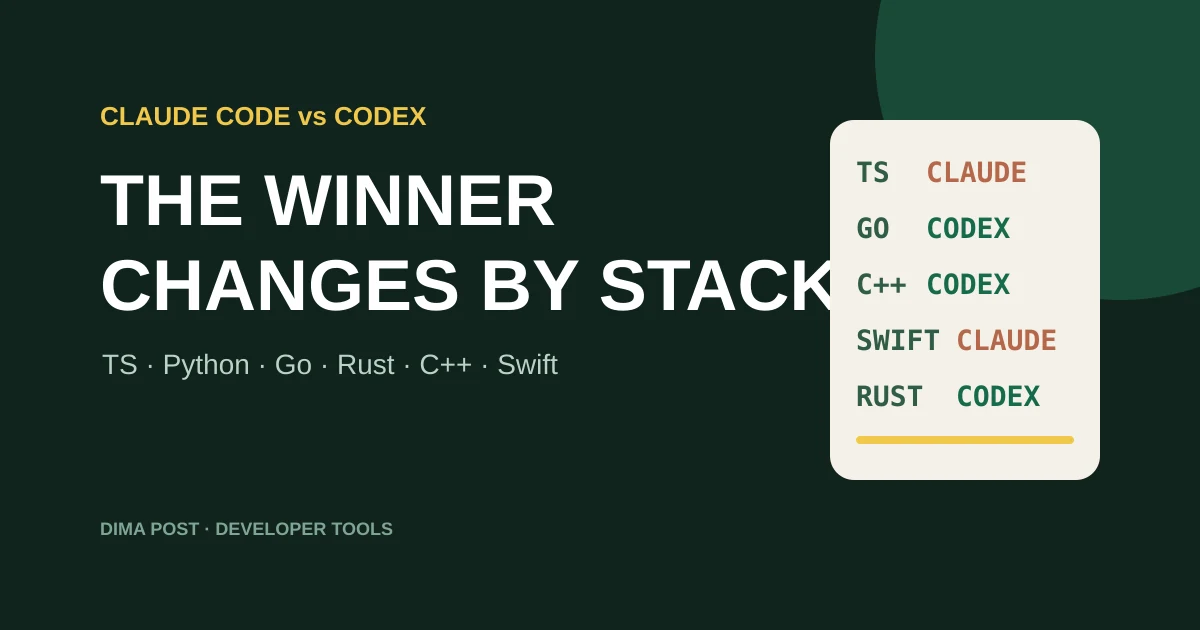
- Claude Code had the clearest edge in TypeScript UI and Apple-platform code; Codex had the clearest edge in Go and C++ repository work.
- Python split by task: Claude produced cleaner small applications, while Codex attracted long-running data work where capacity mattered.
- Fast compiler feedback, existing examples and a browser or deterministic test runner mattered more than syntax alone.
A single “Claude Code or Codex?” ranking hides the most useful part of developer reports. The result changed with the language and, more importantly, with the feedback loop around that language. Building a new React screen, fixing a typed Go library and navigating legacy Objective-C demand different agent behavior.
The language-by-language choice
| Stack | Preferred agent | Why developers preferred it |
|---|---|---|
| TypeScript / React / Next.js UI | Claude Code | Browser checks, spacing, states and first-pass completeness |
| TypeScript libraries | Codex | Shippable patches against explicit tests |
| Small Python apps / Streamlit | Claude Code | Simpler structure and better first-run UX |
| Large Python / R / Stata data work | Codex | More room for long transformation sessions |
| Go backends | Codex | Better requirement coverage in repo-level tasks |
| C++ repositories | Codex | Planning gaps and difficult debugging |
| Rust | Slight Codex edge | Hard Bevy/3D issues; both use compiler feedback well |
| Swift / Objective-C | Claude Code | Framework exploration and existing-code intuition |
TypeScript: Claude for the product surface, Codex for the issue tracker
In a same-guide migration from a roughly 2,000-line Python/Streamlit app to Next.js and TypeScript, Codex finished in 27 minutes and Claude Code in 37. The faster result needed two extra prompts before it worked in the browser. Claude used more code and about 1.5 times the context, but it tested the application in the browser and delivered better spacing, alignment and first-pass behavior.
The result reversed when the work moved away from product UI. A 56-task comparison included 27 real Zod issues. The GPT model in Codex produced patches that passed tests, matched the intended human change and survived review more often. Claude’s smaller diffs were attractive, but the best TypeScript choice depends on whether the missing work is product judgment or a closed acceptance test.
Python: simplicity favors Claude; long data sessions favor Codex
A developer asking both tools for a small PDF text-extraction application found Codex creating a second virtual environment and an unnecessarily elaborate project structure. Claude Code organized the result more cleanly and explained how to run it. Small scripts and Streamlit tools punish over-engineering, so Claude’s restraint was the more valuable capability.
A social scientist working with large administrative datasets in R, Stata and Python switched in the other direction. Claude’s limits interrupted intensive data-wrangling sessions; Codex left far more capacity. The tradeoff was occasional mistakes in subtle transformations. Codex becomes the better data-work tool only when row counts, missing values, aggregate totals and sample records are built into the checks.
Go: the most concrete repository test favored Codex
The 56-task evaluation also contained 29 issues from graphql-go-tools. GPT-5.5 in the Codex CLI was the strongest default for producing a patch the evaluator would ship. Opus wrote smaller changes, but on the Go repository that restraint more often became under-implementation.
Go gives an agent a useful environment: explicit types, a fast formatter, a fast compiler and deterministic tests. Codex’s methodical edit-and-verify behavior had a complete feedback loop. Among the languages reviewed here, Go had the strongest evidence for choosing Codex first.
Rust and C++: difficult reasoning tilted toward Codex
On a medium C++ project of roughly 10,000 lines, a developer gave Claude Code and Codex the same planning tasks. Codex repeatedly produced the stronger plan. When the agents reviewed each other, Codex found omissions in Claude’s plan that Claude then acknowledged.
Rust reports were divided. Daily Claude users praised a full write-compile-test-document loop, while others saw loose typing habits and repeated cleanup. In Bevy 3D work, GPT/Codex repeatedly caught issues that an earlier Opus model failed to understand. Cargo, Clippy and tests make both agents better; Codex had the better reports when the problem required reconstructing a difficult engine or graphics failure.
Swift and Objective-C: Claude understood the existing app better
A developer maintaining a macOS codebase with Swift and legacy Objective-C reported the opposite result. Claude Code explored the existing code and Apple’s unusual API surface more naturally. Codex formed an early assumption, resisted backtracking and introduced its own patterns instead of matching the repository.
That distinction matters in mature Apple applications. Reading headers, testing framework behavior and returning to an earlier hypothesis can be more important than producing a maximally defensive implementation. For that workflow, Claude Code was the clear first choice.
Four signals predict the result better than language popularity
- Fast, strict feedbackGo and Rust improve both agents because the compiler can reject an incorrect assumption immediately.
- Nearby examplesA Scala/ZIO user reported good results when the repository contained a matching pattern and loops when the architecture was new.
- A visible evaluation surfaceClaude’s browser run—not TypeScript syntax—made the migrated UI work on the first pass.
- How open the task isClaude was better at filling product gaps; Codex was better when tests and scope already defined the answer.
Claude Code for frontend and Apple apps; Codex for Go, C++ and backend-critical changes
Route Python and Rust by feedback loop: Claude for small product surfaces, Codex for bounded transformations and hard debugging.
Frequently asked questions
Which agent is better for TypeScript and React?
Claude Code was preferred for greenfield UI, browser validation and product polish. Codex was stronger on closed-scope TypeScript library issues with explicit tests.
Which agent is better for Go?
In the strongest same-task repository comparison, Codex produced shippable patches more often. Claude wrote smaller diffs but under-implemented more of the graphql-go-tools tasks.
Which agent is better for Rust?
Both benefit heavily from compiler feedback. Developer reports gave Codex an edge on difficult Bevy and 3D debugging, while Claude remained effective on ordinary compile-test-fix loops.
Which agent should I use for Swift or Objective-C?
Claude Code received the stronger report for an established macOS codebase because it explored system frameworks and matched existing patterns more naturally.