Codex Subagents Guide: When Parallel Agents Help—or Slow You Down
Subagents accelerate independent exploration, tests and analysis, but parallel edits can create conflicts and coordination drag. Use this official decision framework and task template.
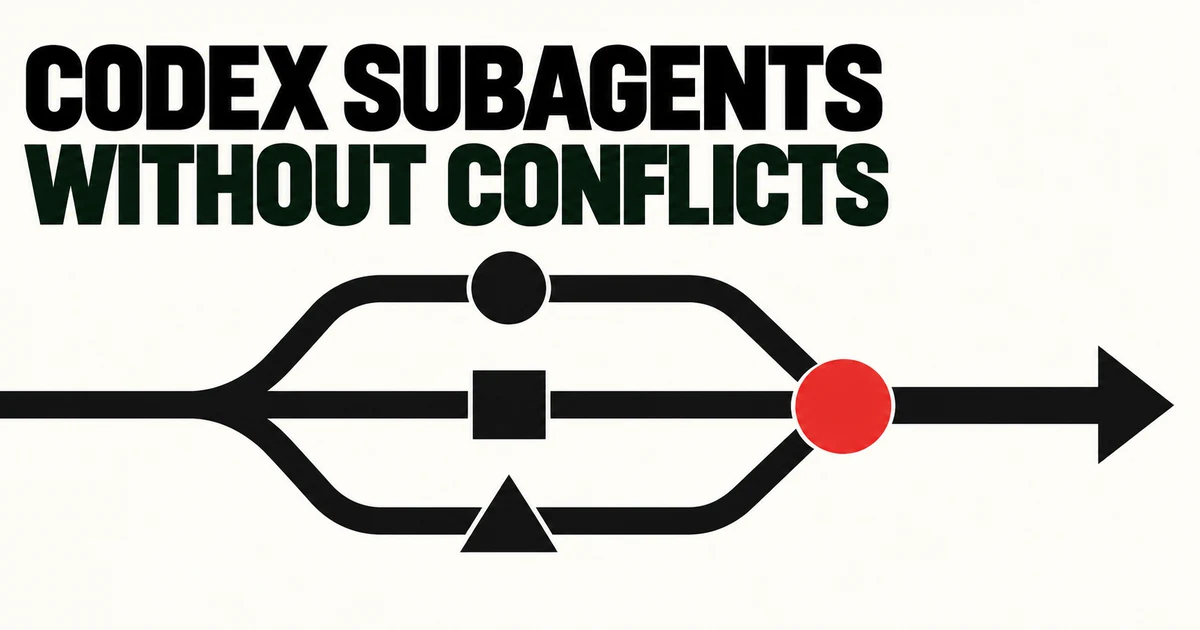
- Subagents are strongest for independent, read-heavy exploration, tests and analysis.
- Each agent performs its own model and tool work, so total token usage increases.
- Parallel edits to shared files can be slower after conflicts and coordination are counted.
Three agents do not automatically make a task three times faster. The real bottlenecks are decomposition and integration. If every branch waits on another result or edits the same code, the merge can cost more than the parallel run saved.
OpenAI recommends starting with read-heavy work such as exploration, testing, triage, log analysis and summarization. Independence—not agent count—is the useful variable.
Subagents reduce context pollution
Large repository scans, test logs and document comparisons can bury requirements and decisions in the main thread. The official guide describes this as context pollution and context rot.
A subagent performs noisy work in another thread and returns a summary. The main agent keeps the user contract, boundaries, integration and final judgment visible.
Good and bad parallel work
A task is a good candidate when A can finish without B, each has a distinct surface, and the return format is clear.
Shared component edits, sequential migrations and work that depends on one unresolved architecture decision should stay serial until the dependency is removed.
- Good: module exploration, independent tests, document summaries, competing hypotheses
- Risky: shared-file edits, common schemas, dependency chains, tiny single changes
A good delegation brief is bounded
“Analyze the project” duplicates the main task. Give each agent a question, read scope, write authority and return format. For write work, assign non-overlapping ownership.
Keep product judgment with the main agent. Subagents return evidence and options; the main thread reconciles conflicts and chooses the implementation.
Agent A: read auth files and tests; return a table of login failure paths; do not edit.
Agent B: reproduce the failing integration test; return the minimal command and ten relevant log lines; do not edit.
Agent C: check official library docs for session-expiry behavior in the installed version.
Main agent: compare all three, select one cause, implement and verify.
Wall-clock speed and token cost are different
Every subagent performs separate model and tool work, so total tokens can exceed a single-agent run. The benefit is elapsed time and isolation of noisy context.
If each subtask takes two minutes, startup, summary and integration overhead can dominate. Delegate meaningful independent blocks, not fragments of one small patch.
Assign ownership before parallel writes
When concurrent edits are necessary, give agents non-overlapping files or packages. Let the main agent integrate shared types and root configuration afterward.
Review diffs, tests and interface compatibility centrally. Delegation does not delegate away verification responsibility.
A 30-second decision rule
If two results must wait on each other, run them serially. If they touch the same file, redraw ownership. If you cannot specify the return format in one sentence, narrow the delegation.
Begin with independent read-heavy work. Add parallel writes only after the workflow demonstrates a real bottleneck reduction.
Prompt for the job, AGENTS.md for repository rules, Skills for workflows, Goals for persistence
Subagents split independent work; MCP connects outside tools and context. Keeping those layers separate makes instructions shorter and execution more predictable.
Frequently asked questions
Does Codex spawn subagents automatically?
Current Codex can delegate when you ask directly or when applicable AGENTS.md or Skill instructions request it. Behavior varies by product and mode.
Do subagents reduce cost?
Usually not in total tokens. They can reduce elapsed time and keep noisy intermediate work out of the main context.
How many subagents should I use?
Match agents to independent workstreams. If there are only two bounded tasks, two agents are enough.
Can subagents edit code in parallel?
Yes, but avoid shared files and interfaces. The main agent should integrate diffs and run final verification.