Keybytes Lets You Rearrange Individual Keys. Is It Ready to Use?
Every key on Keybytes is its own module you can move around, and the creator puts a full-size board at roughly $900. What is still unfinished, and what does that figure really cover?
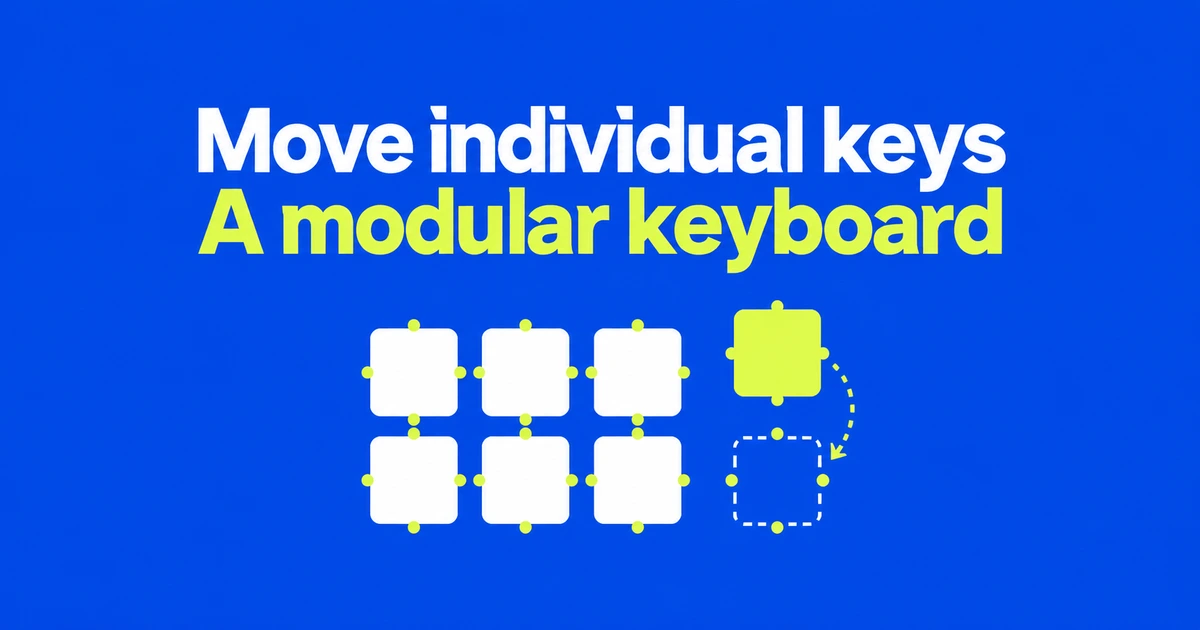
- Each Keybytes key is a separate module that can be repositioned.
- The creator reported a working assembly on October 24 and said in the HN introduction that firmware and additional keys were still in development.
- The roughly $900 full-size estimate is an assembly-cost calculation, not a retail price.
Keybytes is a build to follow, with firmware still underway
Keybytes lets its builder change where individual keys sit. Creator NotARoomba described the motivation on Hacker News: conventional options did not provide the unusual shapes they wanted, such as triangular or circular keyboards. The project makes physical rearrangement part of the design.
The creator reported that an assembly worked in an October 24 journal entry. In the HN introduction, they said firmware work and additional keys were still underway. The public materials describe a developing hardware project. A working assembly is a useful milestone, but it does not establish a finished everyday keyboard.
Magnets hold the pieces; pogo pins carry their connections
The repository names two building blocks. A Keybit contains a Cherry MX switch and a small RISC-V controller. Contacts on its four sides carry power and I2C, while magnetic cases hold adjacent modules together.
The central Keyword module handles USB and Bluetooth. Each key is therefore not a separate Bluetooth peripheral. Rearrangement depends on keeping the physical power and communication connections intact. This changes the board's structure, going beyond exchanging keycaps or remapping characters.
A full-size assembly carries a substantial contact bill
In the October 23 build entry, the creator estimated roughly $900 for an assembled configuration with two Keyword modules and about 110 Keybits. Pogo pins accounted for almost half of that estimate. Buying those parts separately and soldering them personally was a possible way to reduce the expense.
The contacts also created a mechanical problem: their spring force pushed against the magnetic joints. The journal documents stronger magnets and revised cases; the October 24 entry records a decision to glue the magnets after press-fit trials. Reliable attachment is part of the engineering work, not just a cosmetic choice.
Follow the hardware, case files and firmware together
The repository exposes hardware, firmware, CAD and production folders, plus a parts-cost list. The journal points builders to production/CAD for final case STEP files. Those resources describe a fabrication project rather than a checkout-ready kit.
For someone interested in experimenting with physical layouts, the next useful milestones are firmware progress and operation with more connected keys. They will say more about daily usability than the freedom suggested by the modular design alone.